.jpg)
Maximum resistance to harsh chemicals.
Production Information
Sizes :
Customizable to the desired extent.
Production Time:
For stocked materials, 24 hours; for other products, three days after the printing preparation stages (for standard production).
Printing Techniques:
Letterpress, flexo, digital printing
Raw materials:
Coated paper, PET, PP, Data PE
Adhesive:
Acrylic, hotmelt, nonpermanent (removable), standard, strong adhesive.
Finishing :
Lamination, varnish, hot foil printing
Printing :
Color printing, unprinted printing, variable data and barcode printing.
Chemical Industry Labels
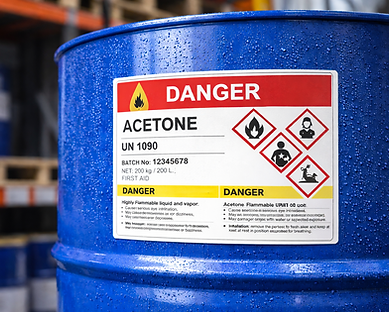
Chemical industry labels are specialized industrial labels that are critical for the safe storage, transport, and handling of hazardous materials. These labels must exhibit high resistance to challenging substances such as acids, solvents, bases, flammable and toxic chemicals.
They are generally made from polyester (PET), polypropylene (PP), or vinyl (PVC) based materials and supported by special adhesives with high chemical resistance. Labels include the product name, ingredient information, batch number, production and expiration dates, safety warnings, and GHS/CLP hazard pictograms.
In addition, printing techniques resistant to water, moisture, UV rays, and corrosive environments are used. In the chemical industry, choosing the right label is of great importance in terms of compliance with legal regulations, occupational safety, and traceability.
Labeling Materials Used
Polyester (PET)
Data PE
Polypropylene (PP)
Vinyl (PVC)
Polyethylene (PE)
Laminated Synthetic Labels
Overall Assessment
The most durable solution: Laminated PET
The most economical solution: Coated paper, PP.
The most flexible solution: Data PE, PVC and PE
Long-lasting technical application: PET
Material Properties
Polyester (PET)
It is preferred for its high chemical resistance, heat resistance, and long service life.
Areas of Application
Chemical drum and container labels
GHS / CLP hazard labels
Tank and stationary equipment information labels
Serial number and barcode labels
Applications requiring outdoor resistance.
Data PE (HDPE)
An economical and practical solution suitable for thermal printing.
Areas of Application
Logistics and shipping labels
Warehouse barcode labels
Temporary identification applications
Vinyl (PVC)
Thanks to its flexible structure, it can be used on curved surfaces such as barrels and drums.
Areas of Application
Warning labels on barrels and drums
Curved surface applications
Large-sized warning signs
Areas requiring flexible surfaces
Types of Adhesives
Solvent-Based Acrylic Adhesive (Most Recommended)
Application: Barrel, metal tank, chemical drum
High chemical resistance
Long-lasting adhesion
High temperature resistance
Outdoor and UV resistance.
It is the safest choice in the chemical industry.
Hotmelt Adhesive (Economical Solution)
Usage: Storage, temporary applications
Fast initial adhesion
Low cost
Limited chemical resistance.
Not recommended for environments with high solvent concentrations.
Freezer/Cold Environment Adhesives
Usage: Cold storage areas
Low temperature adhesion
Condensation resistance
High-Performance Acrylic Adhesive
Applications: PET technical labels, GHS labels
Temperature resistance up to 120°C.
Moisture and solvent resistance
Compatibility with metal and plastic surfaces.
Long-lasting effect
Rubber-Based Adhesive
Usage: For rough and difficult surfaces.
High initial grip
Strong adhesion in plastic containers.
Its chemical resistance is not as high as acrylic.

Polypropylene (PP)
A waterproof and economical solution.
Areas of Application
Product ingredient label
Information label on packaging
Labels used in humid environments.
Medium-level chemical contact applications.
Polyethylene (PE)
It is a flexible and durable solution for chemical drums and plastic packaging. Soft and flexible structure, compatible with plastic surfaces.
Areas of Application
Plastic container and bottle labels
Compressible packaging surfaces
Flexible chemical packaging applications
Laminated Synthetic Labels
Provides extra protection against UV rays, solvents, and abrasion. This extra surface protection enhances wear and chemical resistance.
Areas of Application
Environments with high solvent contact
Outdoor storage areas
Barrels exposed to UV light
Security labels that should not be removed for a long time